


If you have used Salesforce CPQ for years, you do not need another explanation of what configure, price and quote software does. You know the value of controlled product configuration, governed pricing logic and automated approvals. You also know what happens when years of quote rules, customisations and integrations turn a business-critical platform into something that is difficult and expensive to change.
Salesforce CPQ is now end of sale. It is not end of life: existing customers can continue using it, renew licences, add users and receive support. But Salesforce has shifted its strategic investment towards Revenue Cloud Advanced, now part of Agentforce Revenue Management.
That leaves current Salesforce CPQ customers with a decision. You can maintain the existing platform, reimplement your revenue processes on Salesforce’s successor, or use this moment to reconsider whether the wider Salesforce architecture is still the right fit.
For organisations that want to simplify quote-to-cash, improve adoption and connect quoting, billing and payment collection more closely to customer data, HubSpot Revenue Hub presents a compelling alternative.
Salesforce CPQ is supported, but it is no longer the destination
End of sale does not create an immediate migration deadline. There is no official Salesforce CPQ end-of-life date, and claims of a confirmed shutdown timeline should be treated with caution.
The more important issue is product direction. Salesforce is steering future revenue-management investment towards Agentforce Revenue Management and Revenue Cloud Advanced. Existing Salesforce CPQ environments may remain operational, but they are no longer where Salesforce is concentrating new capability.
This changes the business case for every new customisation.
A new quote rule, approval workflow or integration may solve today’s requirement, but it also adds to the estate you will eventually need to assess, redesign or migrate. The longer Salesforce CPQ remains the default without a deliberate roadmap, the more technical and operational debt can accumulate.
The question is not whether Salesforce CPQ still works. It is whether continued investment in it is the best use of your revenue technology budget.
Staying on Salesforce CPQ is a decision, not a neutral position
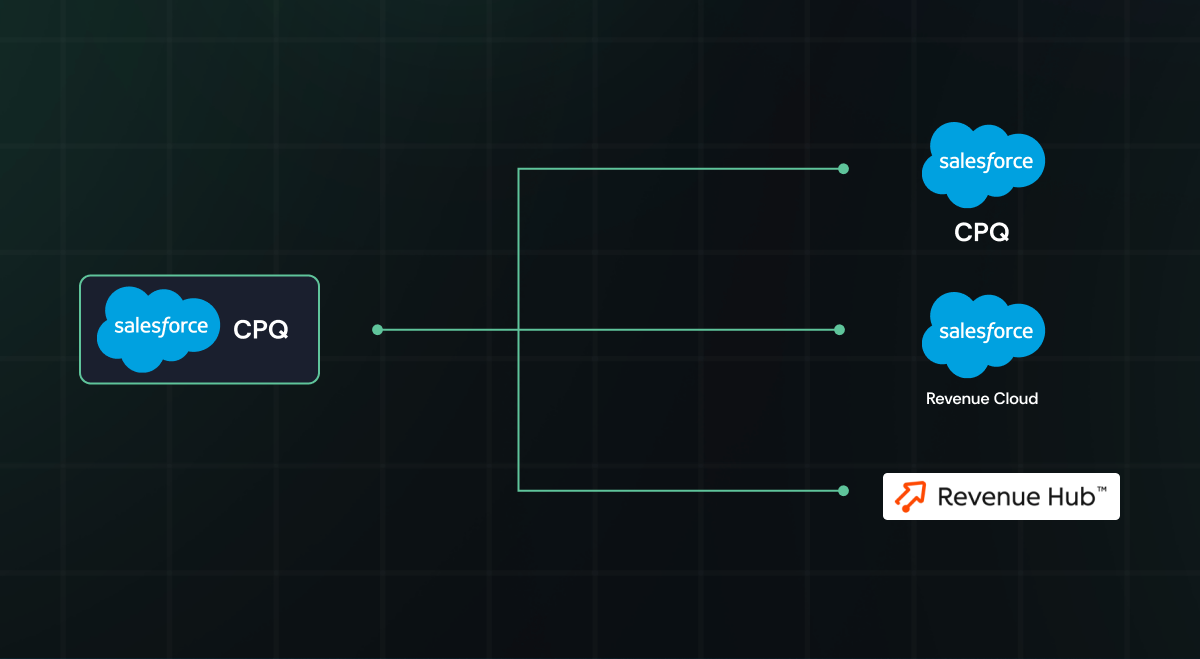
Remaining on Salesforce CPQ can be sensible when the implementation is stable, well documented and aligned with your current revenue processes. It may avoid short-term disruption and give the organisation time to assess its options properly.
But doing nothing still carries costs and risks.
Your scope for innovation narrows
Salesforce’s innovation focus has moved to its newer revenue platform. As pricing models evolve and AI becomes more embedded in quoting, organisations staying on Salesforce CPQ may need additional applications, integrations or custom development to achieve capabilities being built into newer platforms.
Support keeps a product operational. It does not guarantee that the product will keep pace with how your customers want to buy or how your teams want to work.
Complexity keeps compounding
Mature Salesforce CPQ environments rarely contain only standard configuration. They often include years of product rules, price rules, quote rules, approval chains, custom fields, code and integrations with finance, ERP and contract systems.
That depth can be valuable, but it can also make change slow. Updating a product library or introducing a new pricing model may require specialist administration, regression testing and external consultancy. Knowledge can become concentrated among a handful of people who understand why the environment behaves as it does.
The result is a platform that supports complex selling but struggles to adapt quickly when the business changes.
Quote-to-cash can remain fragmented
Salesforce CPQ governs the front of the commercial process, but many implementations rely on separate tools for contracts, e-signatures, billing schedules, invoicing and payment collection.
That creates hand-offs between sales teams, legal, operations and finance teams. It also increases the risk that information on the price quote, contract terms and invoice will diverge.
Where data is copied between systems, revenue reporting becomes harder to trust. Teams spend time reconciling what was sold, what was contracted, what was billed and what was collected.
Total cost goes well beyond licences
The true cost of Salesforce CPQ includes implementation, specialist administration, custom development, integration maintenance, release testing, user training and the surrounding tools needed to complete the revenue process.
For both mid-market and enterprise organisations, the right calculation is total cost of ownership, not price per seat. A platform can be commercially expensive even when its licence cost looks reasonable if every meaningful change requires specialist intervention.
Moving to Salesforce Revenue Cloud is a reimplementation, not a routine upgrade
Salesforce Revenue Cloud is the vendor’s strategic route forward. It expands beyond traditional CPQ into contracts, orders, subscriptions, usage, billing and wider revenue lifecycle management.
For organisations deeply invested in Salesforce, it may appear to be the obvious next step. But moving from the managed-package architecture of Salesforce CPQ should not be treated as a simple version upgrade.
Your product catalogue, pricing logic, quote rules, approvals, CPQ contracts, integrations and data model will still need to be assessed. Processes may need to be redesigned, data migrated and users retrained. In a complex environment, this can become a substantial transformation programme.
That creates a useful decision point: if you need to reimplement core revenue processes anyway, why restrict the assessment to another Salesforce product?
A migration is one of the few opportunities to challenge years of accumulated complexity. It should compare the best future operating model, not simply preserve the incumbent vendor.
Why HubSpot Revenue Hub deserves serious consideration
HubSpot Revenue Hub brings quoting, billing and payment collection into the same customer platform used to manage the deal and the wider relationship. It builds on capabilities previously associated with Commerce Hub and positions them as a connected revenue process.
The strongest case for HubSpot is not that it reproduces every Salesforce CPQ feature. It is that it gives organisations an opportunity to achieve the commercial control they need with a simpler architecture and user experience.
Work from the deal record, not around it
HubSpot Revenue Hub uses the customer and commercial context already held on the deal record. Sales teams can build quotes using known company, contact, deal and product information rather than recreating it in disconnected documents or systems.
That same customer platform can connect marketing teams, sales, service and finance around a shared record. Marketing activity can be linked to the opportunity, sales can manage the commercial conversation, and finance teams can follow the path from agreement to billing and revenue.
This shared context helps reduce duplicate data entry and makes revenue reporting more coherent.
Make quoting easier without abandoning control
HubSpot uses Breeze AI to support quote creation through conversational prompts and a visual editor. That can make the process more accessible to representatives who would otherwise navigate heavily customised screens or rely on operations teams to prepare a quote.
AI should not be allowed to invent a price, ignore contract terms or bypass an approval. Effective CPQ still depends on governed product data, pricing logic and permissions. The advantage is a more intuitive way for users to work within those controls.
This distinction matters: AI can assist the user, while deterministic rules continue protecting the business.
Connect the customer journey from quote to payment
A fragmented buying process creates work for both the customer and your internal teams. A buyer may receive a quote in one tool, sign through another, receive an invoice from a third and pay through a fourth.
HubSpot Revenue Hub brings more of that journey together. Customers can review, sign and pay through a connected experience, while the business keeps the resulting commercial activity closer to the CRM record.
Connecting the price quote, billing schedules and payment collection reduces hand-offs and gives teams better visibility into where revenue is being delayed.
Simplify product and pricing administration
A central product library gives users approved products and prices to work with from the deal. This supports consistency without requiring every routine update to become a technical project.
The migration also creates an opportunity to simplify pricing models rather than reproduce historical complexity. Product bundles, discounts, billing frequencies and approval thresholds can be redesigned around the way the organisation sells now, not the limitations or decisions of an earlier implementation.
Improve adoption across revenue teams
A technically capable CPQ platform delivers limited value when users avoid it. If sales representatives revert to spreadsheets, finance teams rekey data and operations teams become a manual bridge between systems, the intended controls break down.
HubSpot’s user experience is a strategic advantage here. A revenue process that is easier to understand and administer is more likely to be followed consistently across teams, regions and business units.
For enterprise organisations, simplicity does not mean a lack of governance. It means reducing unnecessary friction while preserving the rules that genuinely protect margin, compliance and customer commitments.
HubSpot Revenue Hub vs Salesforce: what are you really choosing?
A feature-by-feature comparison can be useful, but it can also disguise the bigger decision. You are choosing an operating model for revenue, not just a replacement quoting screen.
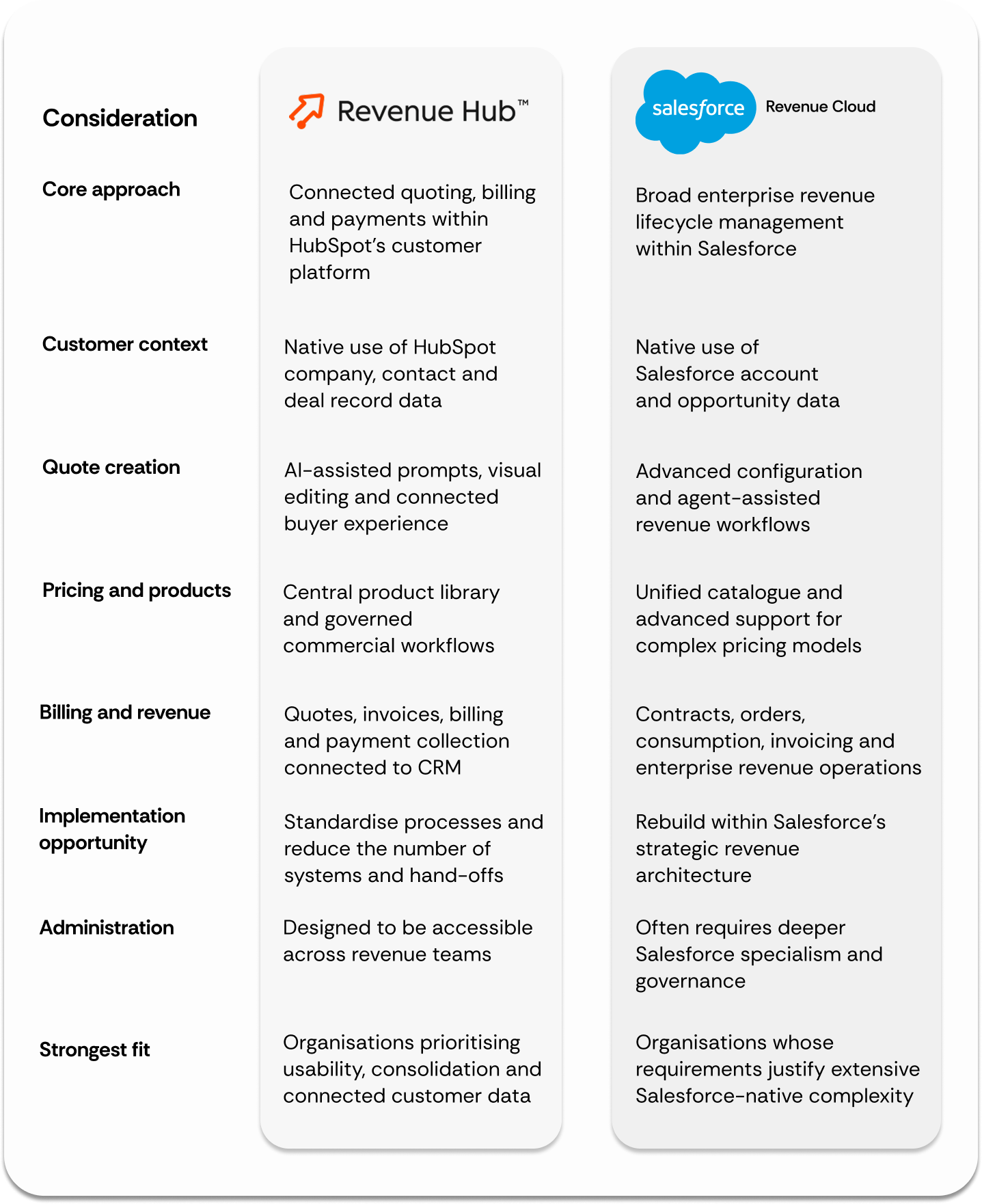
Salesforce Revenue Cloud may offer deeper capability for exceptionally complex catalogues, channels, consumption models or revenue structures. But capability only creates value when it matches a real requirement.
If a large portion of your current Salesforce CPQ complexity exists because of historical customisation, fragmented systems or workarounds, recreating it in Revenue Cloud is not transformation. It is relocation.
HubSpot Revenue Hub is the stronger path when the organisation wants to remove unnecessary complexity, improve the user and buyer experience, and connect revenue processes around one customer platform.
Enterprise requirements do not automatically require enterprise complexity
HubSpot is often associated primarily with the mid-market, but company size alone is no longer a reliable measure of platform fit. Revenue-process complexity is.
An enterprise may operate across multiple regions and teams while still using relatively standard product structures, approval thresholds and contract terms. A mid-market organisation may have highly complex bundles, usage-based pricing and regulatory requirements.
The right assessment asks:
- How complex are the products and dependencies?
- Which pricing models must be supported?
- How many quote rules and exceptions genuinely protect the business?
- What contract terms and approval controls are mandatory?
- How do billing schedules and payment collection work?
- Which integrations are essential?
- What revenue reporting must be available across teams and entities?
- How much specialist administration is the organisation prepared to maintain?
If HubSpot Revenue Hub can meet those requirements through a simpler operating model, organisational size alone should not dictate the need for a more complex platform.
Do not migrate every Salesforce CPQ customisation
The biggest mistake in a CPQ migration is treating the existing environment as a perfect specification for the new one.
Years of configuration contain a mixture of genuine requirements, outdated decisions and technical workarounds. Moving all of it recreates the same cost and rigidity on a new platform.
Review the current estate across:
- Product library and bundles
- Price books and regional pricing
- Pricing models and discount structures
- Product, price and quote rules
- Approval thresholds and sequences
- CPQ contracts, amendments and renewals
- Contract terms and quote templates
- Billing schedules and payment terms
- ERP, finance and data integrations
- Reporting and revenue attribution
Classify each element as retain, redesign or retire.
Retain controls that protect margin, compliance or customer commitments. Redesign requirements that are valid but unnecessarily difficult. Retire products, rules and exceptions that no longer serve the business.
The goal is not to make HubSpot behave exactly like Salesforce CPQ. The goal is to create a better revenue process.
Signs your Salesforce CPQ environment is ready for change
The end-of-sale announcement is a catalyst, but your operating reality should drive the decision. A migration assessment is worthwhile when:
- Sales teams still use spreadsheets beside Salesforce CPQ
- Routine pricing changes require technical specialists
- Quote rules and approval chains are difficult to explain or maintain
- The product library contains duplicates or outdated items
- Contract terms and billing data regularly need manual reconciliation
- Finance teams re-enter information already captured during the sale
- Billing schedules live outside the CRM
- Payment collection is disconnected from the deal record
- Revenue reporting depends on exports and spreadsheet manipulation
- Integrations are expensive or fragile
- Users avoid the approved process because it is too cumbersome
- The business is planning new pricing models or routes to market
- The organisation is already considering a broader Salesforce-to-HubSpot migration
These symptoms affect more than IT. They slow deals, obscure revenue, increase operational cost and make the buying experience harder than it needs to be.
What a controlled Salesforce CPQ migration to HubSpot involves
A credible migration plan begins with discovery, not software configuration.
1. Audit the current environment
Document products, bundles, pricing logic, quote rules, approvals, templates, contracts, integrations and data flows. Identify who owns each area and where undocumented dependencies exist.
2. Map the end-to-end revenue process
Follow representative deals from opportunity through price quote, approval, signature, billing and payment collection. Record every manual hand-off, duplicate entry and reconciliation point.
3. Define the future operating model
Agree which processes should be standardised, what controls must remain and where regional or business-unit variation is justified. This should involve sales, operations, legal, finance teams and platform owners.
4. Prove the difficult use cases
Do not base the platform decision on a polished standard demo. Test your hardest configurations, pricing models, approvals, contract terms, amendments, billing schedules and reporting requirements.
A proof of concept should show where HubSpot fits natively, where configuration is needed and where a requirement should be redesigned.
5. Clean before migrating
Remove obsolete products, expired pricing, duplicated rules and incomplete records before they reach HubSpot. Poor source data does not improve because it has moved platforms.
6. Launch in controlled stages
A phased rollout by team, region, product line or deal type can reduce risk. Run clear acceptance tests and reconcile outputs with finance before expanding the new process.
7. Measure business outcomes
Track quote turnaround time, approval time, pricing accuracy, user adoption, average discount, billing accuracy, payment collection time and administrative effort.
Success is not that every Salesforce CPQ field found a new home. Success is a faster, clearer and more reliable revenue process.
Make the platform decision before complexity makes it for you
Salesforce CPQ is not disappearing tomorrow. That gives existing customers time, but it should not create complacency.
Maintaining Salesforce CPQ means continuing to invest in a product that is no longer Salesforce’s strategic destination. Moving to Salesforce Revenue Cloud means committing to a reimplementation within the same ecosystem. Both options may be valid, but neither should be the default.
HubSpot Revenue Hub offers a more ambitious alternative: use the migration to remove unnecessary complexity, connect customer and revenue data, improve adoption and bring quoting, billing and payment collection closer together.
For organisations willing to challenge inherited processes rather than reproduce them, that is a stronger transformation opportunity than another like-for-like system move.
Start with a CPQ Migration Assessment
Struto’s complimentary CPQ Migration Assessment helps you determine whether HubSpot Revenue Hub can support your requirements and what a controlled move would involve.
We review your Salesforce CPQ environment, including product and pricing complexity, quote rules, approvals, contracts, billing, data and integrations. We then identify what should be retained, redesigned or retired and outline the risks and priorities for migration.
You leave with a practical view of platform fit and a clearer roadmap, not a generic product pitch.
Book your complimentary CPQ Migration Assessment here
For a broader review of the available paths, read Salesforce CPQ Is End of Sale: What Are Your Options?
Frequently asked questions
Is Salesforce CPQ end of life?
No. Salesforce CPQ is end of sale, not end of life. Existing customers can continue using it, renew licences, add users and receive support. Salesforce has not announced an official end-of-life date.
What is replacing Salesforce CPQ?
Salesforce is directing its revenue-management investment towards Revenue Cloud Advanced and Agentforce Revenue Management. Existing customers are not limited to that route and can assess alternatives such as HubSpot Revenue Hub.
Is moving from Salesforce CPQ to Revenue Cloud an upgrade?
It should be planned as a reimplementation rather than assumed to be a routine upgrade. Products, pricing rules, approvals, contracts, integrations and data will need assessment and may need to be redesigned or migrated.
Can HubSpot Revenue Hub support enterprise organisations?
Yes, where its capabilities match the organisation’s product, pricing, contract, billing and governance requirements. Platform fit should be determined by revenue-process complexity, not company size alone.
Why move from Salesforce CPQ to HubSpot Revenue Hub?
HubSpot Revenue Hub can reduce platform complexity, make quoting more accessible, connect activity to the deal record and bring billing and payment collection closer to customer data. It is strongest when the organisation wants to simplify the full revenue process rather than recreate every legacy customisation.
What should be assessed before a Salesforce CPQ migration?
Review the product library, pricing models, quote rules, approval workflows, contract terms, renewals, billing schedules, integrations, data quality and reporting requirements. Each element should be classified for retention, redesign or retirement before the new platform is configured.

