Most organisations should buy a governed AI platform rather than build from scratch or assemble multiple tools. Building demands significant budget, long timelines, and specialist talent. Assembling low‑cost tools increases security and governance risk. A dedicated platform gives you control, efficiency, and scale without the overheads of a custom build.
Why does choosing between build, buy, or assemble matter?
Choosing the right path determines how safely and quickly your teams realise value from Artificial Intelligence (AI). The decision affects security, data governance, total cost of ownership, speed of delivery, and the quality of day‑to‑day workflows. A structured comparison helps you avoid hidden risks and aligns your investment with outcomes your leadership can measure and trust.
What does AI adoption typically involve for most teams?
AI adoption typically involves selecting secure models, connecting data sources, establishing policy controls, and embedding AI into everyday processes such as content creation, reporting, customer service, and operations. Success depends on governance, integration with your existing tools, clear roles and permissions, and the ability to monitor usage and results from a central place.
What are the realities of building your own AI platform?
Building your own platform gives you maximal control over architecture, data handling, and custom workflows. However, it usually requires substantial upfront and ongoing investment, months of engineering time, and access to scarce skills in machine learning, security, and data engineering. You also assume responsibility for maintenance, model updates, compliance changes, observability, and user enablement over the long term.
What are the risks of assembling multiple standalone AI tools?
Assembling many standalone tools appears to have a low initial cost and is quick to start, yet it often fragments work across disconnected apps and introduces data exposure risk if prompts or outputs flow through public models without policy controls. Teams see inconsistent quality because prompts, versions, and guardrails vary by tool. Without central governance, you cannot enforce permissions, audit activity, or standardise outputs, which increases operational risk as usage scales.
Why is buying a dedicated AI platform often the pragmatic choice?
Buying a dedicated platform centralises governance, policy, and permissions so you can control which models are used, what data is processed, and who can do what. A platform standardises prompts, workflows, and review steps so quality is repeatable. You gain faster time to value because the core capabilities are ready to configure rather than build. The subscription model provides predictable costs and reduces delivery risk because maintenance, security updates, and feature upgrades are handled for you.
How does strutoAI support secure, scalable AI in a HubSpot‑first environment?
strutoAI provides a governed workspace that is designed to work alongside HubSpot, so marketing, sales, service, and operations teams can use AI safely inside familiar processes. Role‑based access, policy controls, and content standards help you manage how AI is used, while activity visibility helps you audit prompts and outputs. Because strutoAI is part of Struto’s HubSpot‑first approach, it aligns naturally with the data and workflows in HubSpot CRM, CMS Hub, and Operations Hub, which reduces friction and speeds adoption across teams.
How should you decide which route is right for your organisation?
Start by scoring each option against five criteria that matter to your context: security and governance, time to value, total cost of ownership, integration fit with your core systems, and maintainability over two to three years. If you have a specialised use case, deep internal capability, and a long runway, building may be justifiable. If you need quick wins with strong controls and standardised quality, a dedicated platform is usually the safest path. If you currently assemble tools, define a short migration plan to consolidate under governance.
What is the best next step to move from idea to outcomes?
Define one high‑value use case, the data sources it needs, the policy controls to enforce, and the success measure to track, then pilot under governance before you expand. strutoAI supports this approach by providing a secure workspace, reusable patterns, and alignment with your HubSpot environment so teams can move from experiment to everyday use with confidence. [Results and timelines are based on historical programme data and defined scope. Your outcomes depend on data readiness, resourcing and agreed assumptions. See terms.]
The Comparison Table
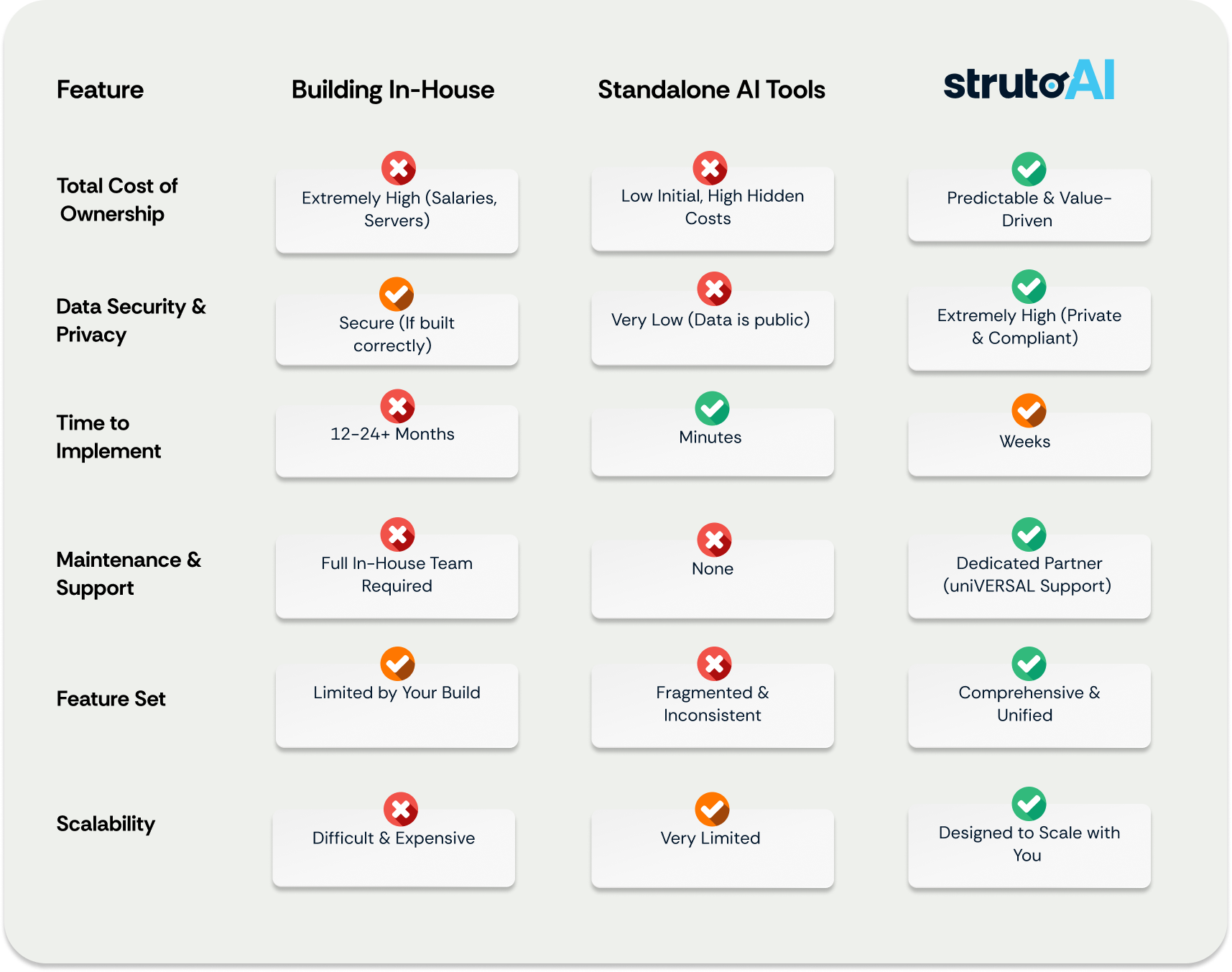
Let’s see how the three options stack up head-to-head.
The Smartest Path Forward
As the table shows, building in-house is too slow and expensive for most, while using standalone tools is too risky and chaotic. strutoAI offers the most logical and strategic balance: the security, power, and scalability your business needs, delivered quickly and with a predictable investment.
If you would like to discuss how strutoAI could fit into your specific technology stack, book a free consultation with one of our advisors.
strutoAI Webinar
Watch our webinar "From Shadow AI to Strategic Asset: How to Secure Your Business in the Age of ChatGPT" on demand.
Learn how to turn the major risk of 'Shadow AI' into your company's secure, competitive advantage.
Join our CEO, Craig Wiltshire, to discover more: Watch the webinar on demand.
FAQ
What is the safest way to introduce AI into a business?
The safest route is to use a dedicated, governed AI platform that centralises policies, permissions, and audit trails. This reduces data exposure risk and provides consistent quality controls compared with unmanaged use of public tools.
When does building an AI platform make business sense?
Building makes sense when you need highly specialised capabilities that off‑the‑shelf platforms cannot provide, and when you have budget, time, and an in‑house team with the skills to design, secure, and maintain the solution over the long term.
Can we combine build and buy approaches effectively?
Yes. Many organisations buy a governed platform for the majority of use cases, then build targeted components for edge cases. The platform handles security, policies, and standard workflows, while custom elements address unique requirements.
How do we protect our data when using AI?
Protect data by enforcing a platform‑level policy that controls which models are permitted, where data is processed, and who can access it. Use role‑based permissions, content standards, and audit logs so you can review usage and remediate issues quickly.
How should we measure return on investment for AI?
Measure return on investment by pairing an outcome metric with a baseline, for example task cycle time, error rate, or lead‑to‑close velocity. Track adoption and quality as leading indicators and confirm improvements against the agreed baseline after rollout.